What are Business Simulations?
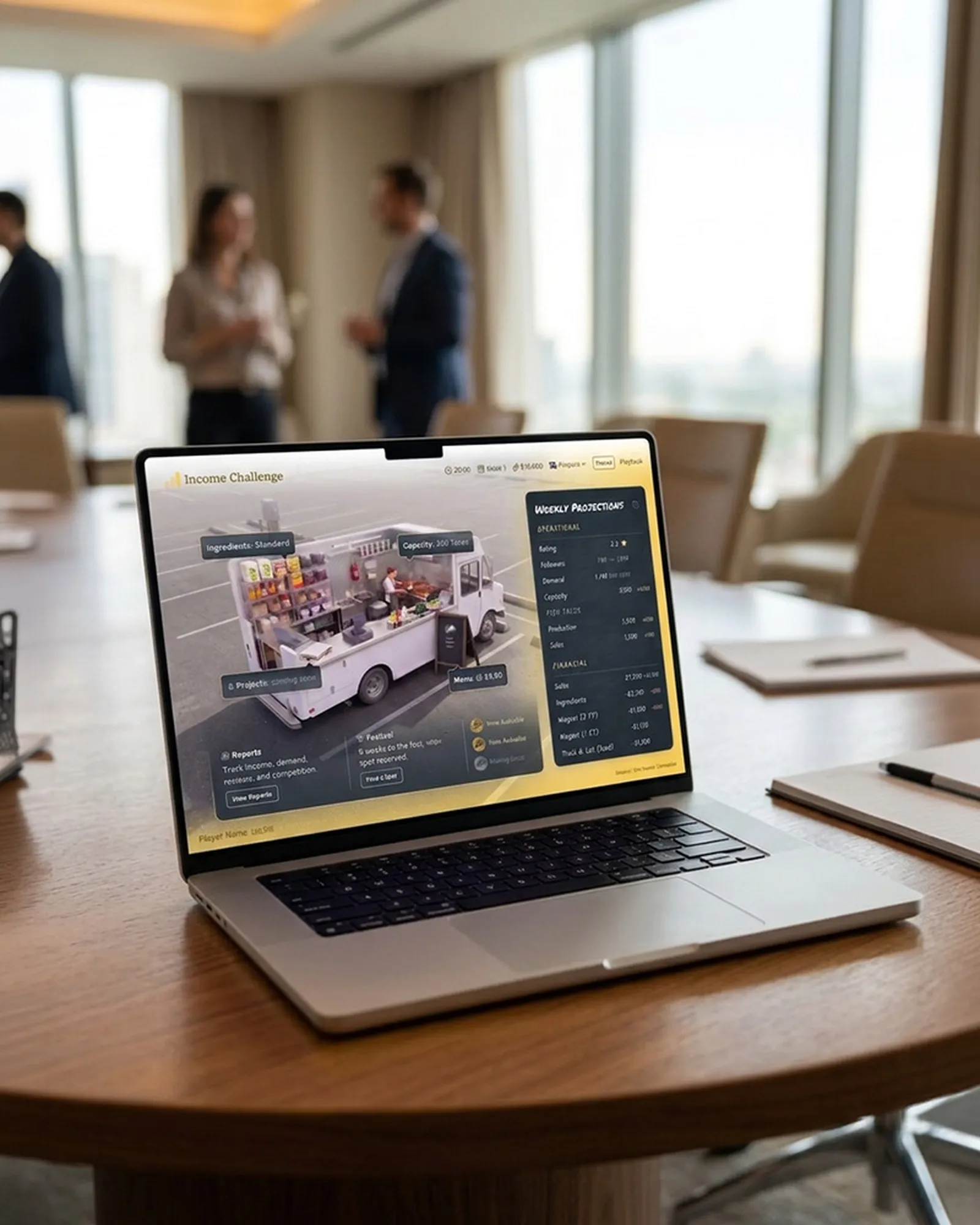
A business simulation is an immersive, experiential practice environment that places participants inside a realistic business scenario, where they make decisions and see the results play out over time.
Instead of listening to an expert explain a framework, participants run a virtual company, lead a simulated team, or navigate competing stakeholders while dealing with limited resources, incomplete information, and unexpected events. Most corporate simulations are team-based and played over multiple rounds, with a facilitator guiding reflection between rounds so participants can connect what happened to their own day-to-day work.

Why simulations are an effective way to develop leaders
Knowing the theory and being able to apply it under pressure are two very different things. In a traditional workshop the expert talks and participants listen, and the frameworks shared are rarely recalled once the pressure of real work sets in. Simulations turn that knowledge into practice. As Kathy Varley, Head of L&D and Talent at CGT Catapult, puts it: "We needed something practical, scalable, and psychologically safe. Our people needed space to practice the human side of leadership."

Built-in engagement: Simulations are time-bound, team-based, and gamified, so participants stay invested from start to finish.
Confidence through safe failure: Leaders can test strategies without consequences and carry that confidence back to their roles.
Real-world pressure: Dynamic conditions and competing priorities mirror the complexity leaders face every day.
Reflection that sticks: Facilitated debriefs help participants make sense of key moments and apply them on the job.
Who are business simulations suitable for?
Simulations adapt to every leadership level, with the complexity of the scenario and the decisions on the table matched to where a leader is in their career.

Rising Leaders
Aspiring, new, and developing managers who need to build foundational business acumen, influence without authority, and practice feedback and coaching.

Experienced Leaders
Directors, senior managers, and leaders of multiple teams who lead cross-functional initiatives, manage budgets, and develop other managers.

Executives
Senior leaders who need to sharpen executive-level judgment, navigate high-stakes decisions, and uncover their own leadership blind spots.
Reasons to use a business simulation
Organizations use business simulations for a range of goals, from building a leadership pipeline to supporting a major transformation. The most common include:
Closing the readiness gap: Leaders often step into bigger roles before they feel prepared, and simulations let them practice those challenging moments before the stakes are real.
Building business acumen: Leaders connect operational decisions to financial statements and learn what drives growth, profitability, and risk.
Strengthening cross-functional collaboration: Simulations let teams debate trade-offs and see how choices ripple across departments.
Developing people-management skills: AI-enabled conversations with simulated direct reports give managers a place to practice feedback and difficult conversations.
Creating a shared leadership culture: Cohort-based programs build peer networks and a common leadership language that lasts beyond the program.
How are business simulations delivered?
Business simulations can be delivered in person or virtually, and most follow the same rhythm over multiple rounds of play:
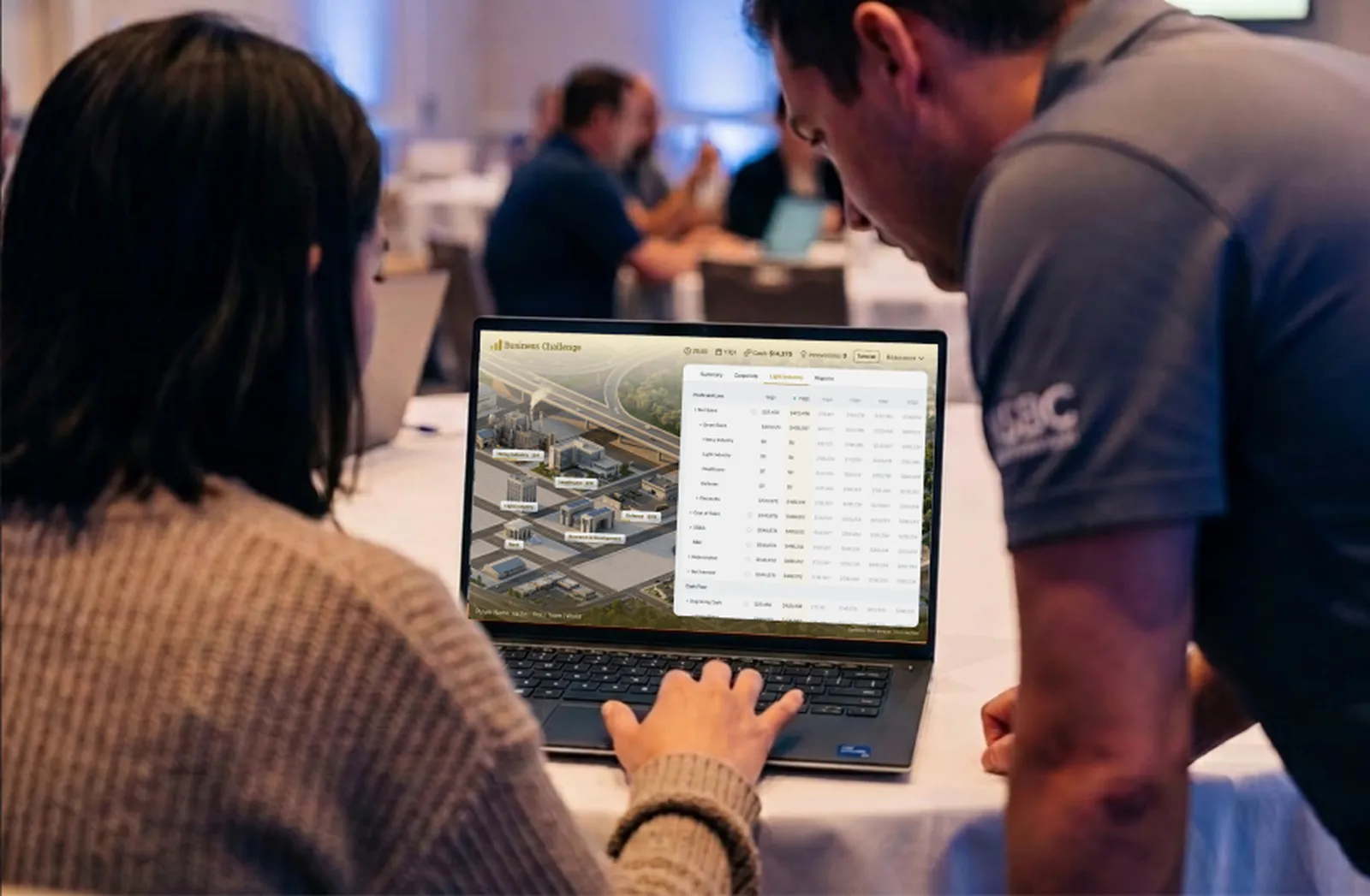
Play
Small teams make decisions inside an immersive, tech-based simulation.

Reflect
Teams review their performance in a facilitator-led debrief.

Apply
Participants connect what they learned to real-world challenges.
Common formats include two-hour case challenges that tackle a single business dilemma, one-day simulations of six to eight hours, and multi-touch learning journeys of 2 weeks to 12 weeks that combine a kickoff, case challenges, and a capstone simulation.
Want to see what this looks like in practice?
The impact of business simulations
When simulations are paired with expert facilitation and structured reflection, organizations see measurable changes in promotion rates, engagement, and leadership confidence. Simulations are also how many employees want to learn. According to SHRM's Workplace Learning & Development Trends report, more than two-thirds of employees prefer learning in a simulation format, and over 50% prefer a coaching or mentoring style.
Accelerating promotions at Baker Tilly
Baker Tilly used simulations within Abilitie's Rising Leader Program to prepare high-potential managers for their next roles. 52% of participants earned promotions, compared with a 22% company-wide average. Participants also reported a 28% increase in holding critical conversations and a 33% increase in confidence delivering executive-level presentations. As Liz Poeschl, Learning and Development Manager at Baker Tilly, shared: "Offering the Rising Leader Program to our high potential managers has helped build our pipeline for future leadership roles."
Closing critical manager skill gaps at CGT Catapult
CGT Catapult's technical experts and emerging leaders lacked confidence and experience in people management. They introduced simulation-based training to turn passive learning into active practice, with results including a 48% promotion rate and 100% increased leadership confidence. One participant said: "It was an excellent opportunity to test approach in a near real-life setting without any consequences or uncomfortable role play."
Additional resources
Looking to go deeper on simulation-based learning? These articles from the Abilitie blog are a good place to start.

Why L&D Leaders Are Replacing Workshops with Simulations
A look at why traditional workshops so often fail to change behavior, and how simulations, expert facilitation, and human connection work together to make learning stick.
How Business Simulations Accelerate Leadership Readiness
Leaders often step into bigger roles before they feel ready. This article explores how simulations help close the readiness gap by letting leaders practice real decisions and build confidence before the stakes are real.
Frequently asked questions
General
It depends on the format. Short case challenges typically run about two hours, while a full-day simulation usually spans six to eight hours. Many organizations combine several of these into a multi-touch learning journey that runs anywhere from a couple of weeks to several months, with a simulation in every session for reinforced practice. View all Abilitie programs
Both. Business simulations can be delivered in person, hybrid, or virtually, and these experiential programs offer the same immersive, team-based experience in either setting. Virtual delivery also makes it easier to bring together cohorts across locations and time zones.
Most leadership simulations are completed in small teams. Cohort-based experiences reflect real work, where collaboration is a necessity, and participants gain perspective from diverse viewpoints while navigating real trade-offs together. Some programs also offer self-paced, asynchronous practice that learners complete on their own between live sessions.
Business simulations are often built around a specific capability. Common types include business acumen simulations, where teams run a company and make financial decisions; cross-functional decision making simulations, where participants collaborate across roles and influence stakeholders; and team management simulations, where leaders coach, provide feedback, and motivate a virtual team. There are also executive simulations focused on enterprise strategy and C-suite decision making.
Yes. Simulations can be designed for the complexity of senior roles, placing executives in cross-functional teams where they take on an executive role, develop a coherent business strategy, and manage financial and people resources in a competitive marketplace. For executives, simulations offer a rare chance to practice enterprise thinking, test high-stakes decisions, and uncover leadership blind spots alongside their peers.