Experiential Leadership Development
Organizations are moving away from treating training as a one-off event and toward multi-touch learning journeys that build capability over time. They increasingly expect leaders to practice, receive feedback, and demonstrate improved judgment, especially in environments defined by speed, ambiguity, and cross-functional execution.
Experiential leadership development sits at the center of that shift. At Abilitie, it has been the foundation of how we develop leaders since 2015, because we believe leaders build capability and confidence through practice, not passive content consumption.
What is experiential leadership development?
Experiential leadership development is an approach to building leadership capability through direct experience rather than passive content consumption. Instead of reading about a framework or watching someone else apply it, leaders work through realistic situations themselves, make decisions, and reflect on the results with the help of peers and a facilitator.
Experiential learning can take many forms, including role playing, structured reflection following real work, and simulated environments. When it is set up well, it creates moments of surprise, the point where a leader's assumption meets an unexpected outcome. Through that surprise, learners are able to learn more than if they were reading from a book or listening to a PowerPoint presentation.

Why experiential learning is an effective way to develop leaders
There's a reason doctors go through residency, pilots train in flight simulators, and professional athletes spend hours drilling before game day. Practice hones skills, develops instincts, and builds confidence, which is just as true for leadership. Several features make experiential learning especially effective for leaders.

It works against the forgetting curve: Psychologist Hermann Ebbinghaus's research on memory, first published in Memory: A Contribution to Experimental Psychology (1885) and replicated in 2015, showed that learners generally forget more than half of their newly acquired knowledge within a matter of hours unless they make a concerted effort to review and retain it. A decision a leader made, defended to their team, and saw play out is far harder to forget than a slide.
It builds pattern recognition through varied practice: When leaders apply the same framework across different stakeholders and constraints, such as time, resources, and risk, they start to recognize patterns. Adaptability is what allows skills to transfer beyond a single scenario and into the messy situations leaders face at work.
It gives leaders permission to try: Many leaders hold back from new behaviors because they worry about getting it wrong in front of others. A trusting, low-stakes environment provides the psychological safety to make the mistakes that lead to growth.
It turns learning into commitment: Well-designed experiential programs end with leaders deciding what they will do differently. As Andy Rosenberg, Director of Learning Programs at Abilitie, describes it: "We have begun to incorporate a simple 'Start, Stop, Continue' exercise to close our programs. This is a way for participants to commit to achievable behavior change based on their learnings."
It harnesses the power of learning together: Leaders learn as much from each other as they do from the content. Cohort-based experiential learning builds those connections by design, creating relationships across the organization that last well beyond the program.

How do business simulations support experiential learning?
Business simulations are one of the most immersive forms of experiential learning because leaders run a business or lead a team through multiple rounds of decisions and live with the results of each one.
The strongest simulations are live, dynamic worlds where participants make decisions and experience the outcomes, rather than static models where they simply input data. Decisions interact with one another in real time, creating evolving conditions that mirror the ambiguity, pressure, and interdependence of real organizations.
Because outcomes are shaped by human behavior, collaboration, and judgment rather than numbers alone, no two simulations play out the same way.
Which leaders benefit most from experiential leadership development?
Experiential learning benefits leaders at every stage of their careers, from first-time managers to senior executives. It is especially powerful when leaders are growing into bigger responsibilities, but its value lies in giving any leader a place to practice the decisions, conversations, and trade-offs in front of them before the stakes are real.

Rising leaders moving from doing to leading
High-performing individual contributors are often promoted into management without ever having practiced judgment, communication, or influence before being accountable for real outcomes. Experiential learning lets them rehearse coaching conversations and financial decisions before their own team is on the line.

Experienced leaders moving from leading people to leading leaders
Directors and senior managers have to shift from managing work to shaping how others lead, and from functional thinking to enterprise thinking. Practice in complex, cross-functional scenarios helps them get comfortable with strategic trade-offs and ambiguity.

Executives moving from functional expertise to enterprise leadership
Senior leaders benefit from practicing high-stakes decisions and communicating as executives alongside peers. The experience can surface blind spots that rarely show up in day-to-day work and test an executive team's ability to respond in high-pressure situations.
In each case, the practice is matched to the scope of responsibility at that level, so leaders build the judgment and behaviors directly relevant to the decisions they will be expected to make.
What skills can leaders develop through experiential learning?
After working with more than 100,000 leaders at hundreds of companies across dozens of industries, Abilitie has found that the capabilities leaders need fall into three universal domains. While these capabilities remain timeless, the conditions leaders face are not, and the leaders who stay effective are the ones who keep practicing as those conditions shift.
Why experiential leadership development matters even more in the age of AI
AI has caused a global reevaluation of how leaders can be effective in a constantly changing world. It is also raising the stakes inside organizations by arming every function with its own analysis and its own version of the truth, while flatter structures mean fewer decisions come with authority attached.
In that environment, the skills that matter most are the ones AI cannot exercise for a leader: judgment, accountability, and influence in situations where technology accelerates decision cycles and amplifies consequences. Human skills such as empathy, ethical reasoning, communication, and sensemaking become more valuable, not less, as AI adoption increases.
Those skills are hard to build through content alone, which is why experiential learning is so well suited to this moment. Well-designed experiences reflect the realities of AI-enabled work: incomplete information, competing priorities, human dynamics, and the need to make decisions alongside intelligent systems.

Trey Reynolds
Chief Technology Officer, Abilitie
AI can also make experiential learning itself more powerful when it is used thoughtfully. In the most effective programs, humans drive learning through practice, while generative AI enhances realism, feedback, and scale. AI-enabled characters let leaders rehearse critical conversations and receive immediate, personalized feedback, and dynamic scenarios can respond to decisions in real time so practice feels less scripted.
The principle that matters most is keeping technology in service of learning. That belief shapes how Abilitie designs its AI-enabled experiences, and it's why our programs are built for pairs or small groups, moving in the opposite direction of most digital learning tools. People don't want to learn in isolation, and after analyzing 25,000 AI-powered conversations, Abilitie found that the most transformative moments still happen when people work through something together.
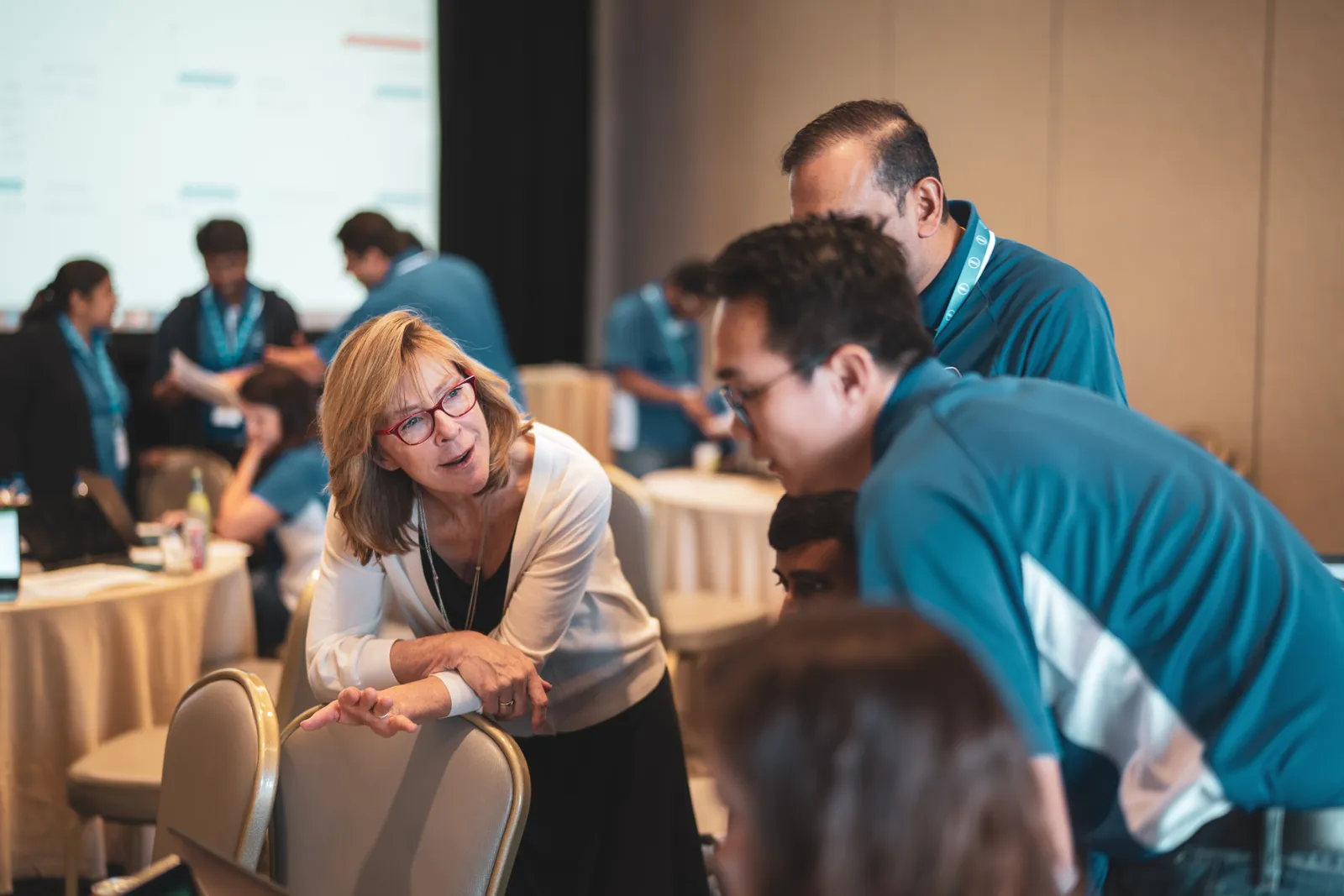
Building leadership through practice
Leadership training continues to evolve toward experiences that build judgment, adaptability, and decision confidence rather than simply transferring knowledge. For L&D teams, experiential leadership development offers a way to close the gap between what leaders know and what they do, giving them a safe place to practice the moments that matter most.